
Best Legacy System Modernization Companies for FinTech in Europe
This guide addresses six practical questions FinTech executives usually raise before approving a modernization budget:
Why are European FinTech teams actively refactoring or replacing heritage software in 2026?
Which modernization approaches - cloud rehosting, selective refactoring, or green-field rebuild - fit specific regulatory and cost goals?
What decision criteria separate an average supplier from a top-tier legacy system modernization company?
Which seven European vendors repeatedly deliver measurable business outcomes for banks, payments, and trading firms?
How do you decide whether to replatform, refactor, or fully rebuild an aging core?
Which industry trends (AI, open banking, DORA, ISO 20022) should influence a 2026 budget request?
Introduction
European FinTech leaders have long relied on incremental patches to prolong the life of legacy cores. Today, that stop-gap strategy is breaking down. Whether it is DORA’s operational-resilience testing, PSD3’s real-time consent flows, or the mandatory ISO 20022 migration window, the mix of compliance and customer expectations is impossible to satisfy by “just adding another service.” In other words, modernization is no longer aspirational; it is essential.
In board meetings, the conversation has shifted from “Should we modernize?” to “Which partner can migrate or rebuild our financial platform without downtime or audit surprises?” The following sections shed light on the most common roadblocks, proven approaches, evaluation criteria, and, most importantly, seven legacy system modernization companies that have already solved similar challenges for European FinTechs.
Why FinTech Companies in Europe Modernize Legacy Systems
Legacy modernization is rarely a vanity project. The trigger is almost always a measurable business risk or opportunity - regulatory fines, rising OpEx, or a new product line blocked by monolithic code. Executives, therefore, expect any proposal to tie technical change directly to operational improvements and revenue expansion.
What Legacy System Modernization Means in FinTech
In financial services, legacy system modernization services for fintech companies replace or transform mainframes, thick-client architectures, and tightly coupled databases that were designed decades before cloud elasticity or open banking consent flows. This often involves API enablement, containerization, CI/CD automation, and the introduction of event streaming for low-latency settlements. The end state is a platform that can scale horizontally during peak trading hours, roll back instantly, and pass regulator inspection without manual evidence gathering.
Why European FinTech Businesses Upgrade Outdated Platforms
Why European FinTech Businesses Upgrade Outdated Platforms. Hard numbers illustrate the urgency. Organizations burdened by aging systems surrender 70% of their IT budgets entirely to maintenance. That's compounded by ever-increasing license fees and a lack of COBOL experts.
Meanwhile, TearSheet notes that cloud-native banks are able to achieve massively greater efficiency, providing access to more than 6,000 customers per employee, versus less than 1,000 per employee at legacy banks. That delta translates into higher margins and faster feature release cycles, which are non-negotiable in competitive markets like BNPL and real-time payments.
When presented in the boardroom, modernization proposals that reference such statistics plus a roadmap for technology, compliance, and cost are more likely to secure funding.
Main Challenges of Legacy Financial Software in Europe
The pain points you hear about most frequently - security gaps, talent shortages, scalability ceilings - are only half the story. Behind each headline is a direct financial impact that hits the P&L. Before diving into a project, smart teams therefore quantify that impact in euros.
Regulatory Lag. A number of changes in the way data is processed and reported are required for DORA resilience testing, PSD3 mandatory APIs and Basel IV liquidity ratios. These rules are embedded in legacy platforms and make updates to comply with the rules is difficult and subject to potential fines.
Security Exposure. As a result, unsupported operating systems are no longer being patched for CVEs in a timely manner, and that is leading to higher cyber-insurance policies.
Scalability Constraints. Holiday shopping spikes can force hardware over-provisioning by a factor of three because vertical scaling is the only option.
Talent Shortage. Retiring PL/I engineers push daily rates sky-high, increasing maintenance budgets.
Integration Friction. Point-to-point file drops fail real-time AML requirements, while frozen batch windows delay credit decisions.
After mapping each challenge to a financial metric, compliance penalties, infrastructure cost, lost revenue, the case for action often sells itself.
Popular Approaches to Legacy FinTech Modernization
Every successful program tailors its approach to risk tolerance, time-to-value expectations, and regulatory context. A one-size-fits-all playbook rarely works, which is why the most qualified legacy system modernization firms present multiple paths up front instead of forcing a single doctrine.
Cloud ReHosting
Cloud rehosting, or “lift-and-shift,” plants existing virtual machines on AWS, Azure, or GCP with minimal code change. The immediate gain is lower hardware and facilities cost, often a 15-25% saving within 12 months. However, unless complemented by automation and monitoring upgrades, it can simply migrate technical debt to a new data center.
Application Refactoring
Refactoring splits a monolith into modular services while applying domain-driven design. Teams replace synchronous database calls with event messaging (Kafka, Pub/Sub) to cut inter-service latency. Legacy fintech application modernization of this kind delivers faster release cadences - weekly instead of quarterly - and eliminates “Friday night deploy anxiety.” Business owners appreciate the reduction in defect escape rates, which directly lowers incident-response overhead.
Platform Modernization & Migration
When the legacy stack is a heavily customized vendor product (e.g., T24, Profile, VisionPLUS), a phased migration to a newer SaaS or PaaS version might be more economical than outright replacement. Migration blueprints include coexistence strategies and data synchronization, ensuring that regulatory reporting lines remain intact.
Rebuilding Legacy Financial Applications
A green-field rebuild becomes necessary when undocumented logic and tightly coupled code prevent incremental change. Modern rebuilds rely on .NET 8, Java 21, or Go with clean architecture principles. Techstack’s component-oriented rewrite of a legacy finance platform on .NET 6 exemplifies how such rebuilds accelerate time-to-market while lowering maintenance effort.
Replacing Core Banking and Financial Systems
The nuclear option is full replacement when the mainframes are at the end of their life or when the vendor support is ending. Operational risk can be reduced by partners who have a track record of data migration strategies and regulator-approved cutover scripts. European institutions that completed such migrations often recoup CapEx within three years, thanks to lower run costs and easier product launches.
Each approach carries different risk-reward dynamics. A firm specializing in legacy system modernization will walk you through quantified trade-offs instead of pitching a single favorite method.
What to Look for in a Legacy Modernization Partner
Selecting a vendor is less about logo size and more about tangible evidence of successful deliveries in similar regulatory environments. The next paragraphs examine five must-have attributes, followed by a tip on validating claims during the procurement cycle.
Experience in FinTech and Financial Services
A partner that has migrated an e-commerce stack but never a real-time settlement engine may underestimate sub-second latency requirements. Always look for at least three European finance case studies within the last five years. Techstack, Endava, and Luxoft all publish such references.
Knowledge of European Compliance & Security Standards
Deliverables should embed GDPR data-protection impact assessments, DORA resilience test scripts, and EBA outsourcing documentation from day one. That breadth of compliance coverage shortens regulator approval and prevents rework.
Enterprise Architecture and Scalability Expertise
Blueprints should take care of peaks, blue-green deployment, and routine failover without the involvement of humans. Have prospective partners share architecture diagrams showing live autoscaling thresholds, cloud cost optimization techniques, etc.
Cloud, DevOps & Automation Capabilities
Toolchain maturity is critical. GitOps pipelines, automated SAST/DAST scans, and self-service deployment portals reduce risk and audit preparation overhead. Review their template repositories or demo an actual pipeline in action.
Experience Modernizing Operational FinTech Platforms
Theory is cheap. Request vendors to provide quantitative pre- and post-numbers: MTTR reduction, batch window reduction, and transaction throughput increase. A reputable legacy system modernization company will provide redacted versions of the snapshots from Splunk or Grafana for proof.
Taken together, these factors separate marketing hype from execution capability. Close a discovery sprint before a full contract to validate working chemistry and delivery processes.
Top Legacy System Modernization Companies for FinTech in Europe
A quick reminder: company sections below focus on verifiable facts, measurable business outcomes, and balanced length, ensuring no single profile dominates. Every partner listed earned its spot through recent European references and domain know-how.
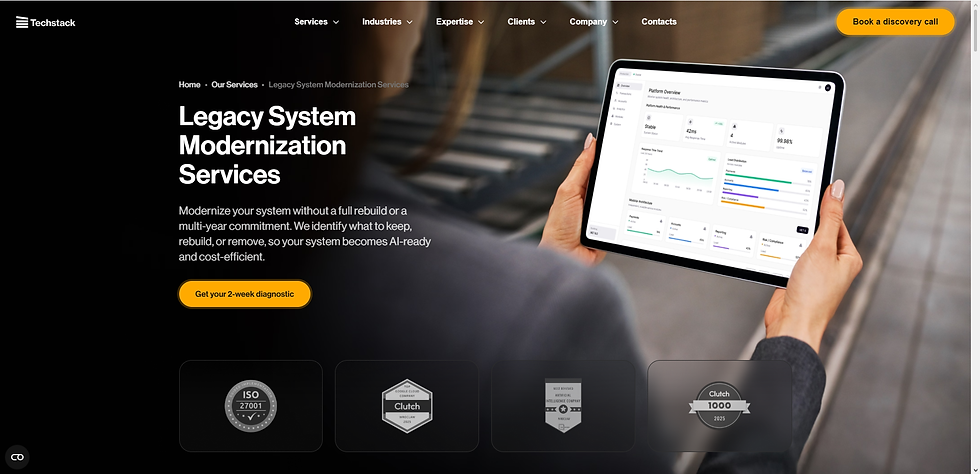
1. Techstack
Source: Techstack
Techstack’s diagnostic-first engagement keeps initial risk low. A two-week assessment maps architecture, data flows, cost sinks, and AI readiness. From there, clients enter one of three tracks - AI Readiness, Cloud Migration, or Full Modernization - based on need rather than vendor convenience.
Legacy financial system platform rebuilt on . With NET 6, there was a 30% reduction in release cycles, and infrastructure costs were reduced. The 5-year partnership with the USA resulted in the creation of a modular AI-enhanced analytics processing platform that was based on a legacy meeting tool, and yet processed analytics 3x faster with no single outage. ISO 27001 certification and long client tenures with 60% of clients staying 5+ years add credibility, making Techstack frequently cited among the best legacy system modernization partners for operational companies in FinTech in Europe.
2. Endava

Source: Endava
Endava’s DAVA-X methodology aligns backlogs with business KPIs rather than just velocity metrics. By embedding live telemetry and replacing manual stage-gates with continuous verifiable assurance, Dava. Flow typically reduces time-to-market by up to 40%. Endava’s PCI DSS and PSD2 artifacts, kept as living documentation, shorten audit cycles, important for institutions nervous about DORA enforcement.
3. Luxoft (DXC Luxoft)

Source: Luxoft
With 200+ capital markets engagements, Luxoft handles high-throughput and low-latency systems that few others touch. It has an Fintech Open Banking practice and enforces strict data sovereignty rules while ensuring API-first architecture capabilities. Luxoft's wealth of experience in the capital markets enables financial institutions to modernize their core trading, risk and post-trade systems for better data processing and compliance.
4. Sopra Steria

Source: Sopra Steria
Sopra Steria’s integrated model - modernization services plus Sopra Banking Software products - reduces multi-vendor risk. Sopra Steria’s 2025 acquisition of Aurexia added over 140 consultants specializing in banking, risk, and compliance. This integrated model, together with their Sopra Banking Software products, makes Sopra Steria a strong player in the field of complex DORA and transformation programs.
5. Intellias

Source: Intellias
Intellias, an AWS Financial Services Competency holder, combines regulatory knowledge with design thinking workshops. Intellias' ISO 8583 to ISO 20022 Converter Accelerator simplifies the conversion of legacy messaging to modern schemas while maintaining built-in validation to guarantee zero downtime when moving to modern schemas. Balanced technical and user-experience enhancements help to keep Intellias firmly on vendor shortlists.
6. SoftServe

Source: SoftServe
With 12,000 engineers, SoftServe scales multi-year modernization portfolios. Its AI-augmented engineering uses automated code analysis, test generation, and CI/CD acceleration. SoftServe’s App Modernization Platform runs on Amazon EKS and deploys in minutes. By migrating legacy workloads to Kubernetes using this platform, clients can see up to a 5X reduction in time-to-market for new features and up to 30% lower cloud infrastructure costs. Clutch reviewers highlight proactive risk management and knowledge transfer.
7. Mphasis

Source: Mphasis
To extract hidden business rules and domain logic from legacy code and artifacts, Mphasis has built its NeoZeta platform natively powered by Gemini Enterprise, which will serve as an AI "Relearn Agent". This ontology-driven knowledge graph accelerates the discovery phase and de-risks enterprise modernization. AI-driven impact analysis differentiates Mphasis in a crowded field of legacy system modernization firms.
How to Choose the Right Legacy Modernization Company in Europe
Selecting a partner often feels like betting the bank, literally, so decisions need structured evaluation.
Start with a quantitative gap analysis. Identify and map existing modernization barriers (such as batch windows, OpEx, and regulatory findings) to modernization strategies (refactor, replatform, and replace) to estimate ROI scenarios. Then write an RFP that requires demonstration and not promises.
During vendor presentations, insist on the following:
A reference architecture embedding compliance and security controls with annotations.
A phase plan including coexistence and rollback scripts.
Transparent cost-benefit timeline with milestone KPIs.
Shared KPI ownership such as MTTR and cost per transaction.
Close with a paid discovery sprint. A firm specializing in legacy system modernization will welcome this because it showcases delivery discipline and de-risks long-term commitments. Conclude vendor scoring using weighted criteria - domain expertise, regulatory track record, cultural fit - and select the best-scoring partner.
Core Technologies Used in Legacy System Modernization
Before choosing tooling, mature partners run a tech-agnostic discovery. Still, common building blocks exist across successful transformations, as summarized below.
Capability | Legacy Pain Point Solved | Typical Modern Tech Stack |
Compute & Orchestration | Vertical scaling limits | Kubernetes (EKS, AKS, GKE), Nomad |
Data Persistence | Single-node RDBMS bottlenecks | Postgres, Aurora, CockroachDB, YugabyteDB |
Messaging & Integration | Batch file transfers | Kafka, Pulsar, Pub/Sub, NATS |
CI/CD and GitOps | Manual deployments, change-drift | GitLab CI, Argo CD, GitHub Actions |
IaC & Automation | Configuration drift | Terraform, Pulumi, Ansible |
Observability | Reactive firefighting | Prometheus, Grafana, OpenTelemetry |
Security & Compliance | Manual evidence gathering | HashiCorp Vault, AWS KMS, OPA, Snyk |
Benefits of Modernizing Legacy FinTech Systems
Any modernization pitch falls apart if it cannot articulate tangible benefits. The key is to link each technical improvement to an operational or financial KPI. Below are five benefits frequently documented in board-level retrospectives.
Regulatory Readiness. Automated policy-as-code inherently simplifies GDPR and DORA compliance. Google Cloud confirms that financial institutions utilizing automated evidence collection reduce audit preparation time by 40 percent.
Lower Run Cost. Cloud elasticity cuts idle-time spend, while retiring proprietary middleware removes six-figure license fees. Cloud migration reduces IT operating costs by forty percent.
Faster Product Delivery. Micro-service modularity enables feature toggles and canary releases. FinTechs using continuous delivery push revenue features weekly instead of quarterly.
Improved Security Posture. CISA confirms that zero-trust service meshes and automated pipelines are foundational defenses that legacy architecture cannot easily retrofit.
Real-Time Data Availability. Streaming architectures enable instant fraud-detection feedback loops and personalized offers, supporting embedded-finance use cases.
Executives appreciate that these benefits roll up into revenue protection and expansion, rather than abstract tech buzz.
Signs Your FinTech Company Needs Legacy Modernization
Modernization should never start because “everyone else is doing it.” It begins with observable triggers tied to risk or opportunity.
Excessive Unplanned Downtime. Two or more major outages in six months breach SLAs and erode customer trust.
Stagnant Feature Velocity. Since deployment is quarterly, new product ideas wait 9 months in the backlog.
Audit Findings. Regulators find unsupported OS versions or hard-coded compliance logic.
Spiraling Maintenance Cost. COBOL contractor rates go up 35% from the previous year.
Integration Backlogs. Onboarding for Partner API takes more than 3 months, which reduces the amount of revenue.
If at least three points resonate, leadership should commission legacy system modernization services for fintech companies' feasibility study. The resulting roadmap reveals the smallest viable modernization step to restore competitive parity. No list stands alone, so we close by reminding readers that quantitative baselines turn these observations into board-ready evidence.
Legacy Modernization Trends in the European FinTech Market
Industry narratives evolve quickly, but four trends have moved from buzzword to budget line item between 2024 and 2026.
AI & Automation in Financial Operations
Modernization projects now embed AI for code analysis and ETF-level anomaly detection. NeoZeta and Techstack’s AI readiness track reduce manual discovery, trimming project timelines by up to 30%.
Cloud-Native Banking Infrastructure
Service meshes are being used more and more by banks for containerized workloads on Kubernetes. Cloud-native patterns enable rapid scaling and self-healing, turning what used to be risky upgrade windows into routine push-button operations.
Open Banking & API-First Architectures
Since PSD2, external API demand has exploded. Modernization now includes building secure developer portals, rate-limiting gateways, and real-time webhooks to power embedded-finance partnerships.
Cybersecurity and Compliance Modernization
With DORA in force, operational resilience testing is a board mandate. Chaos engineering, immutable infrastructure, and live recovery drills are incorporated directly into CI/CD pipelines, shifting compliance “left.”
Each trend signals that modernization is less about shiny new tools and more about disciplined resilience and compliant innovation.
Conclusion
By 2026, the question is no longer whether to modernize but how quickly it can be done without derailing daily operations. The seven vendors profiled, Techstack, Endava, Luxoft, Sopra Steria, Intellias, SoftServe, and Mphasis, excel because they translate technical change into measurable business value: lower OpEx, faster product launches, and audit-proof compliance.
The next step for any executive is a small, data-driven discovery sprint with a shortlisted legacy system modernization company. The right pilot will validate approach, culture, and ROI assumptions, turning an intimidating multi-year journey into a sequence of low-risk, high-impact milestones.
FAQ
How much does legacy system modernization cost for a European FinTech company?
Budgets range from €250k for a focused service refactor to €10-€30 million for a full core replacement. Variables are platform complexity, data-migration scope, and required regulatory artifacts.
What are the biggest risks of outdated financial systems?
Compliance fines, increased maintenance expenses, security violations and slow product delivery, resulting in reduced market share, are all potential risks. Quantification of each risk helps to construct the modernization business case.
Is it better to rebuild or modernize a legacy FinTech platform?
Selective refactoring is feasible if the quality of your code is acceptable and the business logic is still good. If the code is brittle or undocumented, then a green-field rebuild is safer. When hiring a legacy system modernization company to perform a technical assessment, it's easier to see which is the better way to get a higher ROI.
How long does legacy modernization take in the FinTech sector?
Small scope upgrades are completed within 4-6 months. Core replacements are phased over 18-36 months with periods of coexistence to ensure no disruption to customers.
Which European regulations should legacy FinTech systems comply with?
Examples of core frameworks are GDPR (privacy), PSD3/PSD2 (payments), DORA (operational resilience), ISO 20022 (messaging), AMLD 6 (anti-money laundering) and local central bank outsourcing guidelines.